
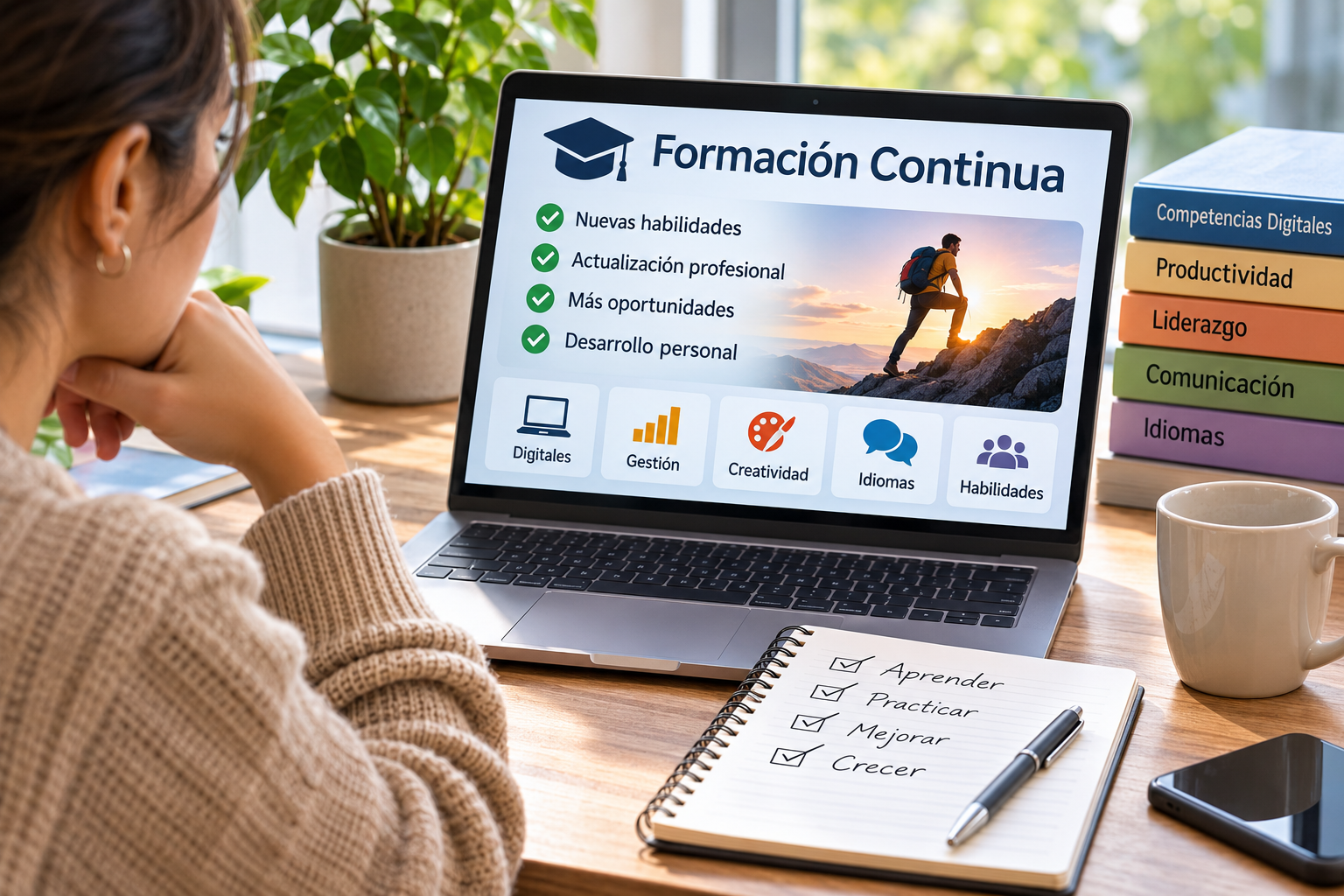
Lifelong Learning: Why Developing New Skills Is Essential for Your Professional Future
Learning does not end when formal education is over. Updating knowledge, exploring new subjects and developing valuable skills can help people face professional changes with greater confidence and preparation.
The world of work is constantly changing. Technology, new business models and evolving company needs mean that many professions develop over time. In this environment, maintaining an open attitude towards learning has become an important advantage.
Lifelong learning allows people to acquire new knowledge, improve existing abilities and adapt to different professional situations. It is not only relevant to those looking for a job or considering a career change. It is also valuable for people who want to improve their performance, take on new responsibilities or stay up to date in their field.
Continuous learning helps build a more flexible professional career and provides useful tools for responding to the challenges of an increasingly dynamic job market.
What Is Lifelong Learning?
Lifelong learning is the ongoing process of acquiring and updating knowledge and skills throughout a person’s life. It can take place through specialist courses, workshops, seminars, educational programmes, workplace training or independent study.
Unlike initial education, which usually takes place during a specific stage of life, lifelong learning has no fixed finishing point. It adapts to individual needs and can continue whenever new goals, interests or professional challenges arise.
For example, an administration professional might learn to use new management software, someone working in retail could develop digital marketing skills, and a technology specialist might update their knowledge of artificial intelligence or cybersecurity.
In each case, the objective is to develop abilities that make it easier to perform effectively in today’s environment.
Why Is Continuous Learning Important?
Training should not be viewed only as a requirement for finding employment. It is also a way to maintain adaptability and make the most of new opportunities.
Adapting to technological change
Digital tools and technologies evolve constantly. Learning how to use them allows people to work more independently and understand new processes introduced by businesses.
Improving career opportunities
Up-to-date knowledge can help professionals apply for new responsibilities, participate in different projects or access positions that require specific skills.
Building confidence and independence
Understanding new tools and developing professional abilities can make everyday tasks easier to manage and help people approach challenges with greater confidence.
Discovering new interests
Learning can also introduce people to unfamiliar subjects, creative activities, personal projects and even completely new career paths.
Skills Worth Developing for the Future
Not everyone needs the same knowledge or abilities. The right choice depends on the industry, previous experience and personal objectives. However, some areas can be valuable across a wide range of professions.
Digital skills
Using computer software, productivity applications, collaborative platforms and digital services has become increasingly common in the workplace. Learning to use these tools effectively can make everyday tasks easier and more efficient.
Communication and teamwork
Expressing ideas clearly, listening to others and working with people from different professional backgrounds are important abilities in modern organisations and collaborative projects.
Organisation and time management
Planning tasks, setting priorities and meeting deadlines can improve productivity. These skills are useful in management positions as well as individual roles.
Languages
Learning another language can make communication with international customers, suppliers and colleagues easier. It also provides access to educational resources and professional opportunities in different countries.
Problem-solving
Analysing situations, identifying difficulties and finding appropriate solutions are valuable abilities in almost every professional field. Training can help people develop a more structured and effective approach to their work.
How to Choose Training That Matches Your Goals
One of the most common challenges is not finding courses, but selecting those that provide genuinely useful knowledge. Before starting a training programme, it is worth taking some time to define what you want to achieve.
1. Identify your needs. Consider which knowledge or skills you are missing and what you would like to improve. Your goal may be related to your current job or a personal interest.
2. Set a clear objective. Instead of simply deciding to learn about a subject, define what you want to be able to do by the end of the course.
3. Compare course content. Review the syllabus and make sure it includes the knowledge you need. A well-organised programme makes the learning process easier to follow.
4. Consider the learning format. You can choose classroom-based, online or blended training. The best option is the one that fits your circumstances.
5. Check the quality of the programme. Find out about the provider, instructors, learning materials and the nature of any certificate offered.
6. Assess your available time. It is better to choose a programme you can complete comfortably than to enrol in several courses you may struggle to finish.
Training should respond to a real need and provide knowledge that can be applied in practice. Choosing carefully helps people make better use of their time and maintain motivation.
Online Learning as a Tool for Lifelong Education
Digital education has made it easier for many people to continue learning without travelling to an educational centre. Online courses provide access to educational content through different devices and allow students to organise their studies around their own schedules.
This approach is particularly useful for people who work, have family responsibilities or live far from specialist training centres. It also makes it possible to revisit learning materials and progress through lessons gradually.
Online learning platforms can include videos, documents, exercises, assessments and other resources that support understanding. Combining different formats allows students to explore subjects from several perspectives.
For those interested in exploring different approaches to education, professional development and multimedia learning, Luis Bonilla offers another resource connected with learning and professional development.
The Role of Businesses in Continuous Training
Organisations also play an important role in developing employee skills. Workplace training allows companies to share knowledge, improve procedures and prepare teams to take on new responsibilities.
A corporate training plan may include technical courses, digital tools, workplace safety, customer service, languages or leadership skills. The choice of subjects should reflect the needs of each department and the organisation’s overall objectives.
In Spain, businesses can use the system of company-funded training for employees and, when they meet the applicable requirements, benefit from reductions in Social Security contributions. FUNDAE provides information about this system and its conditions.
When training is properly planned, it can strengthen teams, support adaptation to new processes and encourage professional development within the organisation.
Practical Tips for Building a Learning Habit
Starting a course can be easy, but maintaining consistency throughout the process requires organisation. Introducing small learning habits into your weekly routine can help you achieve better results.
- Set aside specific times during the week for studying.
- Break the course content into small, achievable goals.
- Take notes in your own words to improve understanding.
- Apply what you learn whenever you have the opportunity.
- Review previous lessons before moving on to more complex topics.
- Recognise your progress and adjust your pace when necessary.
You do not need to spend many hours studying every day. A realistic and consistent routine can be more effective than studying intensively for very short periods.
Learning Throughout Life: A Personal and Professional Investment
The idea of lifelong learning is based on a simple principle: there is always something new to discover and skills to develop. Regardless of age, experience or professional background, learning can help people understand their environment and explore new possibilities.
Continuous education also has a personal dimension. Reading about an unfamiliar subject, learning a language or developing a creative skill can enrich everyday life and encourage curiosity.
Professionally, this attitude makes it easier to face change with greater preparation. People who remain interested in learning have more tools to adapt to new responsibilities and explore different career paths.
Conclusion: Knowledge as a Tool for the Future
Lifelong learning is much more than an additional activity. It is a way to keep knowledge up to date, develop new abilities and prepare for changes in the professional world.
Choosing suitable courses, setting realistic objectives and maintaining an open attitude towards learning can help people make the most of available educational opportunities. Every new skill represents another step towards personal and professional growth.
Frequently Asked Questions About Lifelong Learning
What does lifelong learning mean?
It is the process of acquiring and updating knowledge and skills throughout life. It can take place through courses, workshops, educational programmes, workplace training or independent study.
Who can benefit from continuous learning?
Anyone interested in developing or updating their knowledge can benefit. There are learning opportunities for students, employees, job seekers, self-employed professionals and people from many different industries.
What are the benefits of lifelong learning?
It can improve skills, update professional knowledge, support adaptation to technological changes, strengthen independence and help people explore new personal and career opportunities.
Can I continue studying while working?
Yes. Online learning and flexible training programmes make it possible to organise study time around working hours and other personal responsibilities.
Which skills are worth developing today?
It depends on the profession, although digital skills, communication, languages, time management and problem-solving can be useful across many industries.
Can continuous training help me change careers?
Yes. Developing new skills can help people prepare for a different industry or take on new professional responsibilities. It is advisable to identify the requirements of the desired career before choosing a training programme.