
The results of quality parameters and composition of the VOO from HSSB before and after clarification by VCS and CBSTs in dynamic conditions for the last crop year are shown in Table 3.
Table 3. Quality parameters, minor compounds and bitterness index of the VOO from HSSB before and after clarification by VCS and CBSTs battery for the 2013-14 crop year.
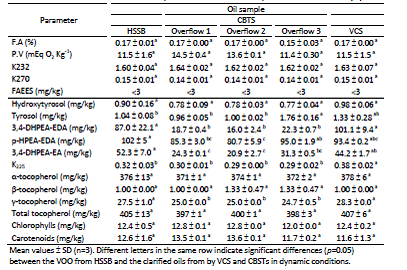
Quality parameters (FA, PV, K232, K270 and FAEEs) let to classify both HSSB and clarified oils into category extra virgin as established by the EU regulation 25, and minor components content for these oils agreed with those values reported for ‘Picual’ oils27.
Regarding to the quality parameters analyzed, the clarified oils were not influenced by the clarification system. In general, a marked increase of the oxidative parameters for the ‘VCS oils’ was not observed, as described Masella et al.10.
The tocopherols (a, 3 and y) and pigments (chlorophylls and carotenoids) content of the clarified oils by both systems did not showed changes regarding to initial content (HSSB oil).
The total phenol content of both HSSB and clarified oils for the last crop year are shown in Figure 2. Phenol content showed losses of 39% when the oil was clarified by CBSTs system. The most important phenol loss was observed in the first CBST, while phenol content remained constant in the other tanks. This decrease, may be explained by the hydrophilic character of phenols, they may be washed by the water during the settling by a drag effect, since around 3 % (Table 1) of oil moisture was removed in the first tank. Similar decrease of total phenol content was observed by Gila et al. 14, for VOO settling under static conditions.
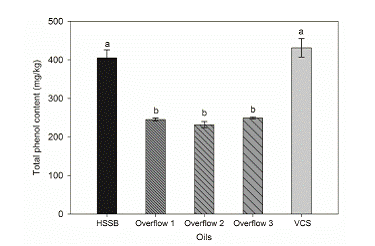
Figure 2. Effect of clarification systems (Battery of CBST and VCS) on VOOs total phenol content for the 2013-14 crop year.
A clear washing effect of the phenolic compounds has been described in different works1,9, in which olive oil clarification was carried out by VCS with substantial water addition (0.4-1.5:1, water:oil), causing higher losses for higher water amount. This reduction can be explained by the partition coefficients of phenols between oil and water28. However, in this work, the oil phenols content were affected when the oil was clarified by VCS, since the water amount was reduced until the mínimum for processing (0.05:1:, water:oil), avoiding this washing effect.
Oil bitterness (K225) presented a similar behavior to the total phenol content. A reduction of this parameter was observed mainly in the first CBST during dynamic settling, while for the VCS oils it remained stable. This behavior was in agreement with that previously described by Beltrán et al. 29, since oil bitterness is directly associated with its phenol content.
Individual phenols (hydroxytyrosol and tyrosol) and secoiridoids (3,4-DHPEA-EDA, p- HPEA-EDA and 3,4-DHPEA-EA) content were also determined. In general, hydroxytyrosol, tyrosol and p-HPEA-EDA content were not affected by the clarification systems used. Decreases of the 3,4-DHPEA-EDA and 3,4-DHPEA-EA content were observed when the oil was clarified by CBSTs, with reductions of 74 % and 40 %, respectively. As observed for total phenol content, the decrease of these components occurred in the first CBST, remaining stable for the others two. These phenols, 3,4- DHPEA-EDA and 3,4-DHPEA-EA, were not practically affected when the oil was clarified by VCS. The different reduction of phenols observed for both clarification systems may be related to the washing effect of CBTS method.
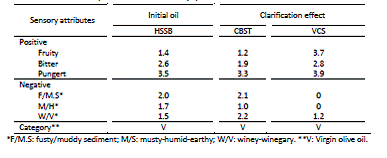
Sensory attributes of VOO from HSSB and its corresponding clarified oils by the two systems are shown in Table 4. Regarding to sensory analysis, the initial VOO from HSSB was classified into ‘virgin’ category as established by the EU regulation25, since sensory defects were detected such as ‘fusty/muddy sediment’, ‘musty-humid-earthy’ and ‘winey-winegary’.
After clarification by both clarification systems, the oils were also classified as ‘virgin’ category. However, for clarified oil by CBSTs battery the sensory defects showed higher intensity, whereas for VCS oil the defect intensity was reduced slightly for ‘fusty/muddy sediments’, where the others (‘musty-humid-earthy’, ‘fusty/muddy sediment’) were not detected. Besides, a higher intensity in the positive attributes (‘fruity’, ‘bitter’ and ‘pungent’) were observed for those oils clarified oil by VCS, because this system preserved the phenol content, and the washing effect was reduced because the low water addition.
Table 4. Sensory characteristics of the VOO from HSSB before and after clarification by VCS and CBSTs battery for the 2013-14 crop year.
4. Conclusions
The experimental results showed that clarification by VCS was more efficient and constant, while CBSTs under dynamic conditions showed lower clarification rates, since the purge system were not able to remove the most of MSOI content.
A slight decrease of the VOO quality was observed when the oil was clarified by CBSTs, due to inefficient purge system, since the presence of MSOI gave anaerobic fermentations that affected negatively both chemical composition and sensory characteristics. Negative sensory attributes were found with higher intensity in the CBTSs oils and a greater reduction of the total phenol content were observed, due to a washing effect produced during the dynamic settling.
The use of minimal water addition during the clarification by VCS reduced the spoilage of the oil quality, since oxidative alterations were not occurred and the oils showed lower sensory defects and higher intensity in the positive attributes than those from settling, the phenol content remained stable.
Therefore, VCS with a minimal water addition, is a quick operation with low water consumption that reduces the wastewater generation, giving VOO of improved quality, that lets to preserve the positive sensory notes.
Acknowledgements
This work was supported by, a fellowship from Ministry of Science and Innovation (Spain) associated to the project FPI-INIA RTA2009-00002-00-0, the grant CAICEM11-67 with the company Pieralisi España SL and the project ‘PI 26323’ from ‘Consejería de Innovación, Ciencia y Empresa’ of the ‘Junta de Andalucía’ (Spain). The authors gratefully acknowledge their financial support.